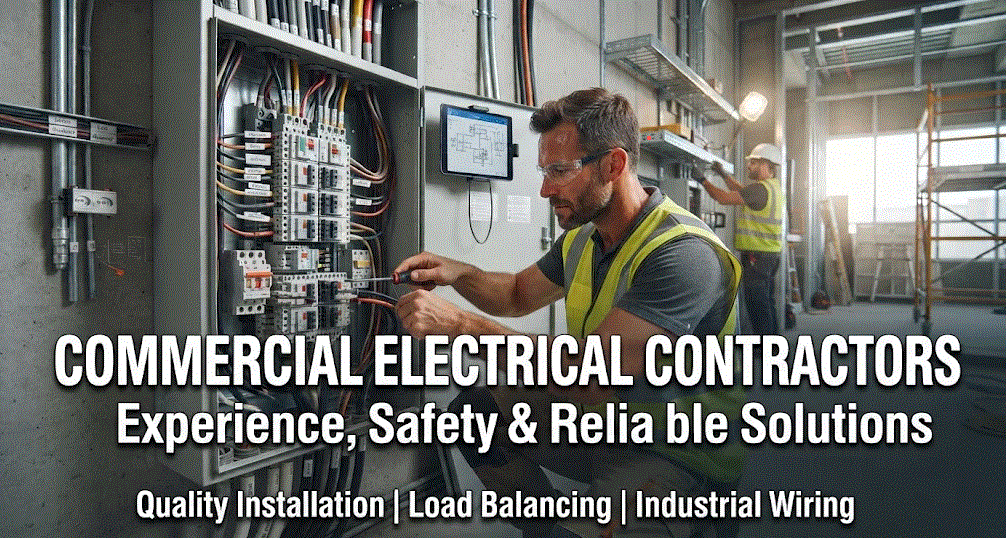
Walk into any newly finished office tower, retail complex, or manufacturing facility, and your eyes naturally go to the glass facades, polished floors, and clean architectural lines. Yet behind those walls sits the real lifeline of the building: its power infrastructure. Designing, installing, and safeguarding that system is the domain of skilled Commercial electrical contractors. Unlike residential wiring, commercial projects demand a completely different level of engineering, load management, safety compliance, and coordination—where a single miscalculation can stall an entire business operation.
Commercial vs. Residential Electrical Work: What Really Sets Them Apart?
A common misconception among property owners is that anyone who knows how to wire a house can handle a commercial build-out. In reality, residential work typically deals with single-phase power and predictable household appliances. By contrast, Commercial electrical contractors manage high-voltage distribution, three-phase power systems, heavy HVAC chillers, server rooms, and life-safety lighting grids.
To put load balancing into simple terms, imagine carrying ten heavy grocery bags in one hand while the other stays empty—you will lose your balance quickly. In a commercial building, load balancing means distributing electrical demand evenly across different phases and circuits so no single breaker or cable is overworked. When done poorly, breakers trip constantly, wires overheat, and expensive equipment wears out early. Experienced Commercial electrical contractors calculate peak and continuous loads down to the last detail, ensuring the building runs smoothly even on its busiest days.
A Real-World Story: When Outdated Wiring Brought Business to a Halt
Consider what happened at a mid-sized distribution warehouse and showroom that expanded rapidly over five years. Management added new packaging lines, upgraded their cold-storage units, and installed brighter display lighting—all without touching the main electrical room. Come mid-summer, every time the air conditioning kicked in alongside the packaging machines, the main breaker tripped, shutting down computers, lights, and loading dock doors for up to an hour at a time.
At first, the facility manager called in general handymen who simply swapped out tripped breakers for larger ones—a dangerous shortcut that masked the symptom while increasing fire risk. Eventually, the owner brought in licensed Commercial electrical contractors for a full system audit. Their thermal imaging and load tests revealed undersized feeder cables running dangerously hot and a main panel operating well past safe capacity. Working over a single weekend to avoid weekday downtime, the team upgraded the main switchgear, ran armored feeder cables, added dedicated sub-panels for the machinery floor, and installed commercial surge protection. Monday morning arrived without a single flicker—and because voltage drop was eliminated, the company’s monthly utility bill actually dropped.
Key Construction Terms Explained Simply
On a commercial job site, blueprints and meetings are filled with technical jargon. Knowing a few core terms helps project owners communicate clearly with Commercial electrical contractors:
- Conduit: Rigid metal or heavy-duty PVC piping that encloses and protects electrical wires from physical damage, moisture, and pests inside walls or exposed ceilings.
- Switchgear: The central hub of circuit breakers, fuses, and switches that controls, protects, and isolates electrical equipment throughout a large building.
- Surge Protection: Heavy-duty devices installed at main and sub-panels to absorb sudden voltage spikes before they fry sensitive computers, POS terminals, or manufacturing controls.
- Grounding and Bonding: Safety pathways that direct stray electrical current safely into the earth, preventing electric shock and reducing fire hazards.
- Three-Phase Power: A method of delivering alternating current using three wires instead of one, providing steady, efficient power for heavy motors and large commercial spaces.
Coordinating on a Live Construction Site
Great Commercial electrical contractors never work in a bubble. During new construction or major renovations, they coordinate daily with civil engineers, plumbers, HVAC installers, and fire-alarm technicians. Conduit runs have to be mapped before concrete is poured, and ceiling boxes must align cleanly with ductwork and sprinkler heads. When Commercial electrical contractors catch a clash on the blueprints early, it saves thousands of dollars in rework and keeps the entire construction schedule on track.
How to Choose the Right Contractor for Your Project
Not every electrical firm is equipped for complex commercial builds. Before signing a contract, evaluate potential Commercial electrical contractors against these core standards:
| Evaluation Criteria | What to Look For | Practical Benefit |
| Licensing & Insurance | Active commercial electrical license, bonding, and liability coverage | Full legal compliance and protection against on-site liabilities |
| Relevant Track Record | Completed projects of similar size, voltage, and industry type | Fewer surprises and faster troubleshooting during installation |
| Safety Standards | Strict Lockout/Tagout (LOTO) rules, PPE compliance, and low incident rates | Safer job site and zero costly regulatory shutdowns |
| Pre-Construction Planning | Detailed load calculations, CAD/BIM coordination, and transparent bids | Accurate budgeting and seamless coordination with other trades |
| Testing & Handover | Megger insulation testing, thermal scans, and labeled as-built drawings | Verified reliability and effortless future maintenance |
Building for Today and Tomorrow
Modern commercial buildings are evolving fast, with EV charging stations, solar integrations, smart lighting controls, and backup generator systems becoming standard expectations rather than rare upgrades. Forward-thinking Commercial electrical contractors leave room in panels and pathways for future expansion, saving property owners from tearing open walls a few years down the road.
Whether you are breaking ground on a new retail center, retrofitting an older office floor, or upgrading industrial power capacity, partnering with dependable Commercial electrical contractors is one of the smartest investments you can make. When the wiring behind the walls is engineered with precision, safety, and foresight, every light, machine, and workstation inside performs without a hitch—day after day, year after year.
Note: General Construction Contractor